A quick note: We have moved to a new home online. This article remains available here on Play4Business, but for our latest articles, workshops, and contact details, please visit us at seriousplaybusiness.com. Thank you for reading!
Last Updated by the Serious Play Business Content Team on July 10, 2026.
LEGO® SERIOUS PLAY® for Workplace Inclusion
Executive Summary
LEGO® SERIOUS PLAY® for workplace inclusion is a structured facilitation approach that helps employees make experiences, assumptions, and organizational barriers visible. Instead of relying only on verbal discussion, participants build models, explain their meaning, and examine the interdependent forces that influence belonging and participation.
For leadership teams, the methodology creates a practical route from general inclusion commitments to specific organizational actions. For consultants and HR professionals building facilitation capability in 2026, it also offers a disciplined process for leading sensitive conversations without reducing inclusion to a presentation or awareness exercise.
LEGO® SERIOUS PLAY® for workplace inclusion helps organizations examine who participates, whose knowledge influences decisions, and which structural constraints prevent people from contributing fully. The methodology works because every participant builds and shares before the group moves toward collective interpretation, which leads to broader participation and more visible organizational insight.
Why Workplace Inclusion Often Fails to Become an Operating Reality
Workplace inclusion is the degree to which people can contribute their knowledge, perspectives, and concerns without being marginalized by hierarchy, habit, or organizational design. Inclusion matters because diverse representation produces limited value when employees do not influence decisions or feel safe enough to question prevailing assumptions.
Many organizations describe inclusion as a cultural value while continuing to operate through meeting structures, promotion practices, and communication patterns that favor a narrow group of voices. Employees may be invited to attend discussions without having a meaningful effect on the outcome.
Representation changes who is present, while inclusion changes whose knowledge becomes part of organizational decision-making.
The distinction is critical. A team can be demographically diverse and still rely on the same two or three people to frame problems, evaluate ideas, and determine priorities. The result is apparent participation without genuine influence.
In conventional meetings, 20–30% of participants may occupy most of the available speaking time. The exact pattern varies by team, but the organizational consequence is consistent: valuable information remains unspoken, and decisions reflect a smaller evidence base than leaders assume.
The problem is systemic rather than interpersonal. Hierarchy, time pressure, psychological safety, language confidence, professional status, and previous experiences form interdependent forces. When one force discourages contribution, feedback loops can reinforce silence across the wider organization.

The Organizational Cost of Exclusion
Organizational exclusion occurs when formal or informal structures repeatedly prevent people from contributing, being heard, or influencing outcomes. Exclusion creates costs because it weakens information flow, slows issue detection, and reduces employees’ willingness to invest discretionary effort.
Employees notice when leaders request honest input but reward agreement. They also notice when difficult experiences are acknowledged during a workshop but disappear from subsequent decisions.
Employees disengage from inclusion initiatives when organizations request personal honesty without demonstrating how that honesty will influence systems or decisions.
The immediate cost may appear as cautious participation. Over time, however, the wider effects can include lower trust, delayed escalation of operational risks, avoidable turnover, and weaker collaboration across functions.
Replacing an experienced employee can require several months of recruitment, onboarding, and role-specific learning. When exclusion contributes to unwanted turnover, the organization loses both the individual and the relational knowledge connecting that person to customers, processes, and colleagues.
Exclusion also affects strategic execution. A leadership team that does not hear operational concerns early may approve plans based on incomplete assumptions. Those assumptions then move through budgets, performance measures, and team priorities, which leads to expensive correction later.
Inclusion becomes strategically relevant when broader participation improves the quality, speed, and resilience of organizational decisions.
Serious Play Business approaches inclusion as an organizational system rather than a single training topic. That framing shifts attention from individual intention toward the structural conditions that determine who can participate and how their contribution is treated.
Why Traditional Inclusion Approaches Often Fall Short
Traditional inclusion training is usually designed to transfer information, increase awareness, or clarify expected behavior. These goals can be useful, but information alone rarely changes the feedback loops, power relationships, and operating routines that shape everyday participation.
Presentation-led sessions often place participants in a passive role. A small number of people speak, while others listen, interpret privately, or avoid contributing because the subject feels politically or emotionally risky.
A verbal discussion can reproduce the same power dynamics the organization is trying to examine. Seniority, confidence, language fluency, and conversational speed continue to influence who frames the issue.
Traditional discussion privileges people who can formulate an immediate verbal response, while structured building gives every participant time to develop meaning.
Another limitation is abstraction. Words such as belonging, equity, voice, respect, and psychological safety can mean different things to different people. Teams may agree that inclusion is important without agreeing on what inclusive behavior looks like during hiring, planning, conflict, or performance management.
LEGO® SERIOUS PLAY® for workplace inclusion creates a contrast with presentation-led training. Participants do not merely receive definitions. They construct representations of experience, explain those representations, and examine the patterns that connect individual stories to organizational systems.
The aim is not entertainment, informal play, or an icebreaker. The aim is strategic facilitation that allows complex organizational experience to become visible, discussable, and actionable.
The Cognitive and Methodological Foundation
Thinking through the hands is a process in which physical construction supports reflection, meaning-making, and communication. It matters because people often understand more about an experience than they can immediately express through conventional conversation.
The LEGO® SERIOUS PLAY® Method uses a four-step process: the facilitator poses a carefully designed challenge, participants build, each participant shares the meaning of the model, and the group reflects on what has been revealed.
The process has no right or wrong model. Participants retain ownership of the meaning attached to what they build, which reduces the risk that other people reinterpret or invalidate their experience.
Physical models externalize sensitive issues, allowing teams to examine relationships and constraints without reducing the conversation to personal accusation.
Metaphor also supports depth. A wall may represent restricted access. A disconnected figure may represent isolation. A bridge may represent sponsorship, trust, or a missing organizational relationship. The model gives the participant a concrete reference point for explaining an abstract experience.
For a fuller explanation of the process, read what LEGO® Serious Play® is and how it works. The methodology overview explains the relationship between 100% participation, thinking through the hands, individual models, shared models, and facilitated reflection.
These elements matter in inclusion work because the quality of the outcome depends on more than open conversation. It depends on a process that distributes participation while preserving the meaning of each person’s contribution.
How LEGO® SERIOUS PLAY® Supports Workplace Inclusion
LEGO® SERIOUS PLAY® for workplace inclusion is an application of the methodology to questions of voice, belonging, access, influence, and organizational behavior. The application works by moving from individual experience to shared patterns and then to collective commitments.
Participants first build their own responses. This protects independent thinking because people are not required to align with the first opinion expressed by a senior or confident colleague.
Each participant then explains the model. The group listens to the model’s meaning before debating solutions. As a result, the organization gains access to perspectives that may not appear in ordinary meetings.
Equal building time does not eliminate organizational hierarchy, but it prevents hierarchy from controlling the first stage of collective sense-making.
The physical landscape can also reveal systemic relationships. Teams may connect leadership behavior, recruitment practices, workload allocation, promotion criteria, meeting culture, and informal networks. The completed landscape shows that inclusion is rarely produced by one policy or one leader.
System Models can help participants identify feedback loops. For example, limited access to high-visibility assignments may reduce promotion readiness, which leads to continued underrepresentation at senior levels. The model makes the cycle visible and gives the group a structure for asking where intervention is possible.
Serious Play Business uses strategic facilitation to connect these insights with organizational alignment. The purpose is not to secure superficial agreement. The purpose is to establish a shared understanding of current conditions, desired conditions, and the decisions required to close the gap.

Workshop Guide: Building a More Inclusive Workplace
An inclusive workplace workshop is a facilitated process that helps participants identify barriers to contribution and develop shared operating commitments. The outline below can be adapted for leadership teams, cross-functional groups, culture initiatives, or organizational change programs.
Teams improve inclusion when they identify the operating conditions that suppress contribution rather than attributing silence to individual confidence.
Click the ‘+’ button below to explore the detailed workshop stages.
1. Establish Participation & 2. Individual Experiences of Inclusion
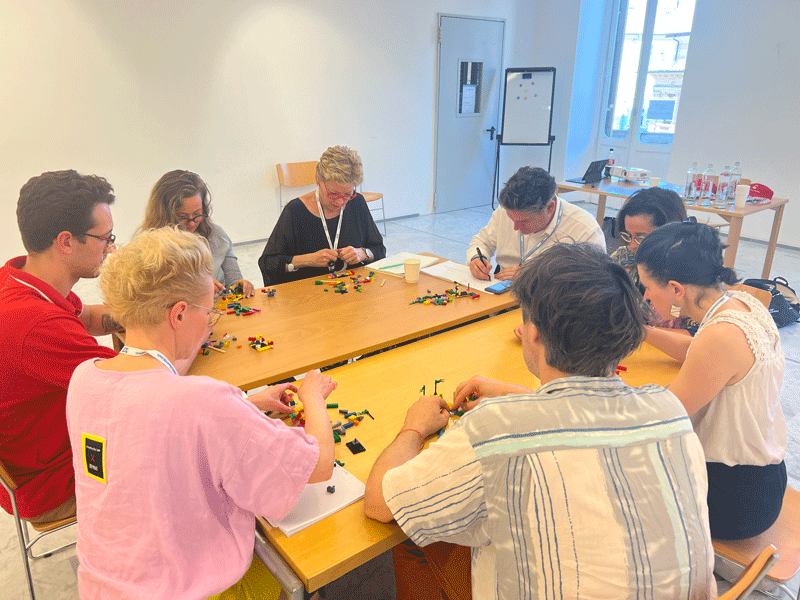
1. Establish Participation and Model-Building Skills (20–30 minutes): The facilitator introduces the purpose, confirms confidentiality boundaries, and explains that participants will discuss models rather than judge building ability. The facilitator prompts a simple skills build, such as: “Build a model showing one condition that helps you contribute your best thinking at work.” Participants build silently before sharing. The group reflects on the range of conditions represented, such as clarity, trust, access to information, autonomy, or recognition. This stage matters because participants need confidence in the process before addressing more sensitive organizational experiences.
2. Build Individual Experiences of Inclusion (30–40 minutes): The facilitator prompts: “Build a model of a workplace experience in which you felt your contribution was genuinely included.” Participants build silently and give the model a title. Each person explains what happened, which conditions enabled contribution, and what organizational behavior made the experience possible. The facilitator asks questions about the model rather than interrogating the individual. The group records recurring systemic enablers without forcing consensus.
3. Identify Barriers & 4. Create a Shared Model
3. Identify Barriers and Structural Constraints (35–45 minutes): The facilitator prompts: “Build the most significant barrier preventing people from contributing fully in this organization.” Participants may represent hierarchy, inaccessible information, informal networks, inconsistent leadership behavior, meeting design, workload, or fear of negative consequences. Each participant shares before the group looks for connections. Diagnostic Cards may be introduced by a trained facilitator to test how particular events or decisions could strengthen or weaken the barriers.
4. Create a Shared Model of an Inclusive Organization (45–60 minutes): The facilitator invites participants to select essential elements from the individual models. The group combines these elements into a shared model representing the organization at its most inclusive and effective. Participants negotiate meaning rather than simply combining every object. The facilitator prompts the group to explain why each element is essential and how the elements depend on one another. The finished shared model may include transparent decision pathways, leadership accountability, equitable access to opportunities, safe challenge, and visible feedback mechanisms.
5. Stress-Test the Shared Model & 6. Guiding Principles & Ownership
5. Stress-Test the Shared Model (30–45 minutes): The facilitator introduces realistic scenarios: a restructuring, leadership transition, rapid growth period, budget reduction, merger, or conflict between functions. Participants modify the model to show how the inclusive system would respond. The group identifies weak connections, unintended consequences, and structural constraints that could cause exclusion to return. Road Maps can then connect the shared model with short-term and medium-term actions.
6. Define Guiding Principles and Ownership (30–40 minutes): The facilitator prompts the group to convert the shared model into three to five guiding principles. Each principle must describe observable organizational behavior. For example: “Decisions affecting a team will include structured input from that team before approval.” Participants assign ownership, evidence measures, review dates, and escalation routes. The group reflects on what leaders must stop, start, or continue doing.
The complete workshop usually requires approximately three to four hours. Complex organizational change initiatives may require a full-day format or a sequence of sessions.
Outcomes and Strategic Relevance
Organizational outcomes are the specific changes in behavior, decision quality, and operating practice produced by the intervention. Naming these outcomes matters because “better inclusion” is too broad to guide implementation or evaluation.
A well-designed workshop can help organizations achieve at least three distinct outcomes.
First, teams identify conflicting assumptions before those assumptions become embedded in culture initiatives or leadership decisions.
Second, leaders gain a visual map of the structural barriers connecting meeting behavior, opportunity allocation, communication, and employee trust.
Third, participants produce observable inclusion principles that can be integrated into decision-making, talent processes, and team routines.
A shared model creates organizational alignment by giving participants a common reference point for evaluating future behavior and decisions.
Additional outcomes may include stronger cross-functional understanding, earlier identification of exclusion risks, and greater clarity about leadership accountability.
Within organizational change initiatives, the workshop can be positioned as a diagnostic and design process. It should not be presented as a one-time solution for every cultural challenge.
In leadership development contexts, the method can help leaders examine the difference between intending to be inclusive and creating systems that make inclusion possible.
As part of facilitator certification journeys, professionals learn how to sequence challenges, protect participant ownership, and connect model insights with actionable outcomes. Skilled facilitation matters because sensitive topics require careful contracting, neutral questioning, and disciplined management of group reflection.
For organizations looking to hire a facilitator, the selection process should consider methodological competence, organizational experience, ethical judgment, and the ability to translate workshop insights into strategic action.
Take the Next Step
Serious Play Business helps leadership teams, consultants, and HR professionals turn general inclusion commitments into specific organizational actions through strategic facilitation.
To understand the full methodology behind the workshop design described above, read The LEGO® Serious Play® Method explained.
Frequently Asked Questions
How does LEGO® SERIOUS PLAY® for workplace inclusion work?
LEGO® SERIOUS PLAY® for workplace inclusion works by asking every participant to build and explain models representing experiences, barriers, and desired organizational conditions. The models make abstract issues visible and support structured reflection before the group develops shared commitments.
Can LEGO® SERIOUS PLAY® be used for sensitive inclusion conversations?
LEGO® SERIOUS PLAY® can be used for sensitive inclusion conversations when the session is led by a competent facilitator with clear boundaries and an appropriate workshop design. The method supports psychological safety, but it does not replace safeguarding, grievance, or formal investigation processes.
How is an inclusion workshop different from conventional diversity training?
An inclusion workshop is different from conventional diversity training because participants actively examine their organizational system rather than only receiving information. The workshop connects individual perspectives with structural barriers, feedback loops, and operating decisions.
Does every participant have to be experienced with LEGO® models?
Every participant does not have to be experienced with LEGO® models because the facilitator begins with skills-building challenges. Participants are evaluated on the meaning they communicate, not on the appearance or complexity of a model.
What organizational issues can the workshop address?
The organizational issues an inclusion workshop can address include meeting participation, leadership behavior, access to information, promotion pathways, workload allocation, cross-functional relationships, and psychological safety. The facilitator defines the scope before the session.
Why is facilitator certification important for inclusion work?
Facilitator certification is important for inclusion work because the facilitator must design precise questions, manage participation, protect model ownership, and avoid imposing personal interpretations. Certification provides a methodological foundation for leading structured sessions responsibly.