Last Updated by the Serious Play Business Content Team on June 29, 2026.
LEGO® SERIOUS PLAY® Participation: Why Full Contribution Reshapes Organizational Conversations
Executive Summary
LEGO® SERIOUS PLAY® Participation refers to the structured involvement of everyone present in a facilitated organizational conversation. By 2026, no organization can afford sessions where only 20–30% of the room decides the outcome.
For consultants and HR professionals developing facilitation capability, participation is no soft extra—it is a design requirement for sharper thinking. For leadership teams, the method provides a disciplined route to surface assumptions, test meaning, and reach shared understanding before any decision is locked in.
LEGO® SERIOUS PLAY® Participation matters because every person builds, shares, and reflects before the group settles on a conclusion. The approach lowers dominance bias, shields quieter voices, and converts invisible thinking into models everyone can see. Once participation is built in rather than left to chance, organizations draw more accurate insight from the people nearest the work.
What Participation Means in LEGO® SERIOUS PLAY®
LEGO® SERIOUS PLAY® Participation is the method-engineered state in which everyone contributes something meaningful—through building, telling stories, listening, and reflecting. It matters because most organizational discussions are governed by rank, pace, confidence, and ingrained meeting habits, and those forces produce incomplete decisions and unspoken resistance.
In plenty of leadership workshops, what gets said out loud doesn’t capture the group’s full intelligence. A senior leader opens, a confident voice expands on it, and everyone else quietly trims their own views to match the prevailing reading. The team can then walk out with agreement that is more for show than real.
LEGO® SERIOUS PLAY® Participation breaks that cycle by handing each person a model, a story, and protected airtime. Because participants build in silence before describing their models, the pressure to answer on the spot eases and everyone gets time to think for themselves.
Participation improves decision quality when every person contributes meaning before the group negotiates conclusions.
Serious Play Business treats this as a defining feature of the LEGO® SERIOUS PLAY® Method, not an optional facilitation flourish. For the wider methodology behind this participation structure, read The LEGO® Serious Play® Method explained.
The Real Cost of Partial Participation
Partial participation describes the pattern where only some of the people in the room actively steer the discussion, the interpretation, and the decisions. It matters because the most talkative people are not always those holding the most relevant insight, and that gap leaves blind spots across strategy, culture, change, and execution.
In a standard 10-person meeting, two or three voices can comfortably take up 60–75% of the airtime. The problem runs deeper than lopsided communication: weak signals go unheard, the realities on the ground are underreported, and disagreement is pushed back until the implementation stage.
Silent participants often carry operational knowledge that leaders need before strategy becomes execution.
When contribution is lopsided, organizational alignment turns brittle, because people may go along in the room while holding back concerns that resurface later as resistance. Leaders mistake that silence for consensus, which drags out execution and triggers repeated clarification meetings.
The cost climbs in complex systems. Culture, leadership, communication, and strategy all act on one another. Suppress contribution in one place and feedback loops weaken across the whole organization. A team can believe it has cracked a problem when it has only heard from its most comfortable speakers.
For a mid-sized leadership team, a single badly designed alignment workshop can generate weeks of rework when the decision overlooks practical constraints. Expect anywhere from 10–30 hours of follow-up discussion, particularly when unresolved assumptions resurface after commitments are already on the table.
Why Conventional Workshops Struggle to Reach 100% Participation
Conventional workshops rarely achieve full participation because they lean on verbal speed, confidence, seniority, and open-discussion formats. That matters because such formats favor the people already at ease speaking, producing the familiar rhythm of dominance and silence.
A typical workshop may invite everyone to chip in, but an invitation is not a structure. Open prompts like “What does everyone think?” tend to draw uneven responses, because people run quick social calculations first—weighing rank, risk, relevance, timing, and whether their point might land as disruptive.
Standard brainstorming also splits idea generation from deeper meaning. A group can generate plenty of suggestions yet never grasp the assumptions, tensions, or personal readings underneath them. The result looks lively without ever becoming strategically useful.
Open discussion rewards speed and confidence, while structured building protects depth, reflection, and equal contribution.
LEGO® SERIOUS PLAY® Participation departs from ordinary facilitation because everyone answers the same prompt by building first. The model becomes a thinking artifact rather than an ornament. No one has to fight for the opening word, because the process sets a clear order: prompt, build, share, reflect.
That contrast matters for strategic facilitation. Traditional workshops often push people to agree out loud before they have clarified what they actually mean. LEGO® SERIOUS PLAY® lets the group externalize thinking first, which produces more grounded interpretation.
The Cognitive Basis: Thinking With Your Hands
Thinking with your hands is the idea that physically building something can help people reach, organize, and voice knowledge that’s hard to put into words directly. It matters because organizational knowledge is frequently tacit, emotional, relational, and tied to context—so it doesn’t always surface through ordinary discussion.
In LEGO® SERIOUS PLAY® sessions, participants don’t start by arguing over concepts. They build models that capture how they understand a challenge, system, relationship, or future state. Building slows the conversation and opens a different path into meaning for the brain.
This carries weight in leadership and culture work, where so many issues are abstract. Trust, accountability, strategic uncertainty, customer value, and readiness for change resist tidy one-line definitions. Building a model gives participants a visible anchor for describing those abstractions.
Physical models help teams discuss complex issues because the object carries meaning before debate begins.
The method also takes the pressure off producing polished language right away. A participant can point at part of a model and say, “This is the bottleneck,” or “This is the part of the system we keep ignoring.” The object supports the explanation, drawing clearer contributions from people who might not dominate a spoken debate.
That’s why LEGO® SERIOUS PLAY® Participation isn’t entertainment. It is about disciplined cognitive access, structured expression, and shared interpretation inside real organizational settings.
How Participation Plays Out in Practice
LEGO® SERIOUS PLAY® Participation operates by weaving together individual model-building, storytelling, reflective questioning, and shared meaning-making. It matters because the process keeps individual thinking separate from group convergence, so early consensus can’t narrow the conversation too soon.
The facilitator opens with a carefully framed question. Participants build in silence, which protects independent thought. Each person then explains what their own model means. The group listens before it interprets, building a discipline of attention that standard meetings usually lack.
The method’s four steps—question, build, share, reflect—engineer participation by design. There are no right or wrong answers, because each model holds the builder’s meaning, and that keeps the group from judging contributions prematurely.
LEGO® SERIOUS PLAY® creates inclusion by designing contribution into the process rather than requesting it from participants.
In alignment work this structure is especially useful. Leaders often find that people use identical words but load them with different meanings. A team might all say “customer focus” yet build sharply different models of what it demands in day-to-day decisions.
Serious Play Business applies the method in corporate settings where participation has to deliver real organizational results. The aim isn’t simply to hear from everyone—it’s to assemble a more accurate picture of the system before leaders commit to action.

Workshop Blueprint: Designing for Full Participation
A LEGO® SERIOUS PLAY® participation workshop is a structured session built so every attendee builds, explains, listens, and helps shape shared interpretation. It matters because the facilitator engineers the conditions for equal contribution rather than waiting and hoping it appears on its own.
Click the ‘+’ button below to explore the detailed workshop stages.
1. Set the Purpose & 2. Build Individual Models
1. Set the Purpose and Participation Contract — 15–20 minutes: The facilitator helps the group understand why they’re there and what participation will involve, spelling out that everyone builds, everyone shares, and each model’s owner controls its meaning.
Participants hear that the session isn’t about artistic talent, fast answers, or performance. The facilitator stresses there are no right or wrong answers—granting psychological permission without letting the workshop drift into something casual.
2. Build Individual Models of the Current Challenge — 25–35 minutes: The facilitator asks each participant to build a model of the present organizational challenge—a leadership bottleneck, an alignment gap, a culture tension, or a barrier to change. People build in silence so each can form an independent reading before hearing anyone else.
Once built, every participant explains their model in turn. The facilitator guards airtime and blocks interruptions, and the group listens for meaning, patterns, and differences instead of rushing to fix the issue.
3. Surface Assumptions & 4. Build a Shared Model
3. Surface Assumptions and Systemic Connections — 30–40 minutes: The facilitator prompts the group to consider what each model reveals about the broader system, reflecting on interdependent forces, structural limits, feedback loops, and the enablers within the system.
Participants may see that a single issue touches several parts of the organization—unclear decision rights, for instance, can shape accountability, speed, trust, and customer responsiveness all at once. The facilitator helps connect individual insights without forcing them into one premature conclusion.
4. Build a Shared Model of the Participation Pattern — 35–45 minutes: The facilitator invites the group to build one shared model of how participation actually works in the organization today. Participants negotiate meaning through the model rather than through abstract argument.
Together they pinpoint where voices get amplified, where they vanish, and where information stalls as it tries to move across the system. The shared model reframes participation as a question of organizational design, not personality.
5. Translate the Model Into Decisions & 6. Close With Commitments
5. Translate the Shared Model Into Decisions — 25–35 minutes: The facilitator asks the group to name the practical implications—specific behaviors, meeting structures, decision points, or leadership habits that need to change.
The guiding question is, “What must be protected, changed, or clarified if this model is accurate?” That moves the session from insight to action while keeping the meaning the group created intact.
6. Close With Commitments and Reflection — 15–25 minutes: The facilitator asks each participant to name one commitment tied to the shared model, and the group reflects on what shifted because everyone took part.
The facilitator records the named outcomes, the tensions still open, and the next steps. This closing stage underscores that participation isn’t finished until insight has turned into organizational movement.
What Stronger Participation Produces
The payoff from LEGO® SERIOUS PLAY® Participation isn’t merely a livelier workshop. It’s a fuller picture of the organization—one leaders can use to decide better, build sturdier alignment, and shrink hidden resistance.
The first result is wider contribution. People who normally wait, defer, or self-censor now hold a defined role in the process, and that changes the information the group has to work with.
The second result is sharper organizational alignment. Participants can tell whether they’re using the same words to mean different things, so misalignment shows up before it gets expensive.
The third result is earlier risk detection. Because each person builds from their own vantage point, weak signals and operational constraints can surface before leaders lock in a plan.
The fourth result is firmer commitment. People back a decision more readily when their own thinking was part of making meaning.
Teams align faster when assumptions become visible before decisions are finalized.
The fifth result is better leadership learning. Leaders watch not only what people think but how the group makes sense of complexity together—valuable feedback on communication habits, trust, and the quality of decisions.
In change initiatives this is pivotal, since change collapses when people comply in public but disagree in private. LEGO® SERIOUS PLAY® Participation gives the organization a sharper way to tell the two apart.
What Facilitators Need to Understand About Participation
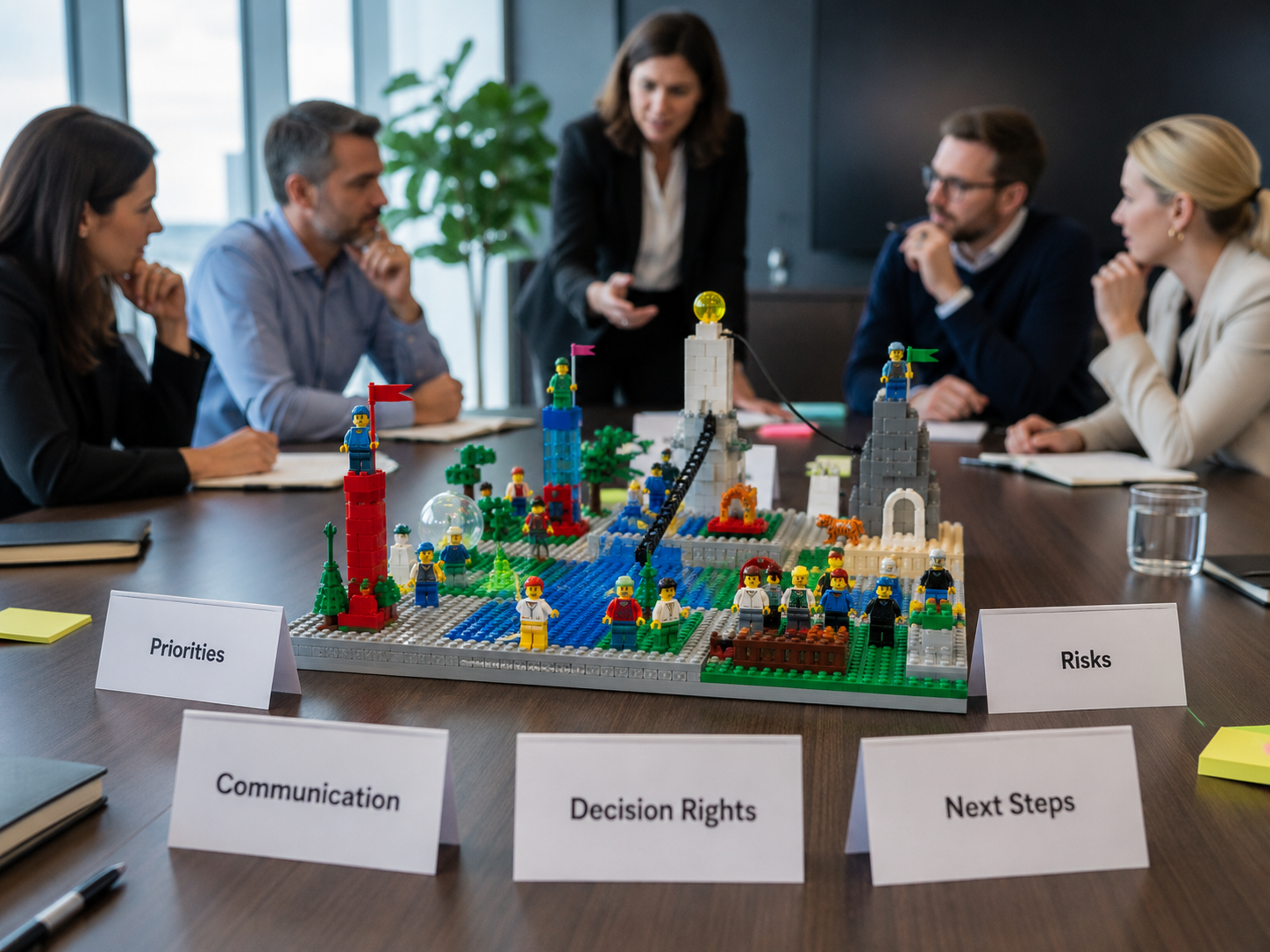
Facilitator competence is the disciplined ability to design, hold, and steer a process that protects participation and generates meaningful organizational insight. It matters because the method lives or dies on structure, timing, question design, and interpretation discipline.
A facilitator has to know how to word prompts that invite depth without confusing the room. They also have to protect silence while people build, manage airtime as people share, and stop anyone from interpreting another person’s model before its builder has explained it.
Through facilitator certification, professionals come to see that participation isn’t conjured by enthusiasm alone. It is produced through method integrity, sequence, and restraint—and the facilitator has to resist the pull to over-explain, rescue, or nudge the group toward a preferred answer.
Facilitators protect participation by managing sequence, airtime, silence, and meaning ownership throughout the workshop.
LEGO® SERIOUS PLAY® Tool use, Build Levels, and System Models can support the work when trained facilitators treat them as method artifacts. These terms should never harden into product language; they only matter insofar as they help facilitators deepen organizational thinking.
For any organization hiring a facilitator, the real test isn’t whether the session feels lively. It’s whether the facilitator can generate 100% participation that yields useful business insight.
Participation as a Strategic Capability
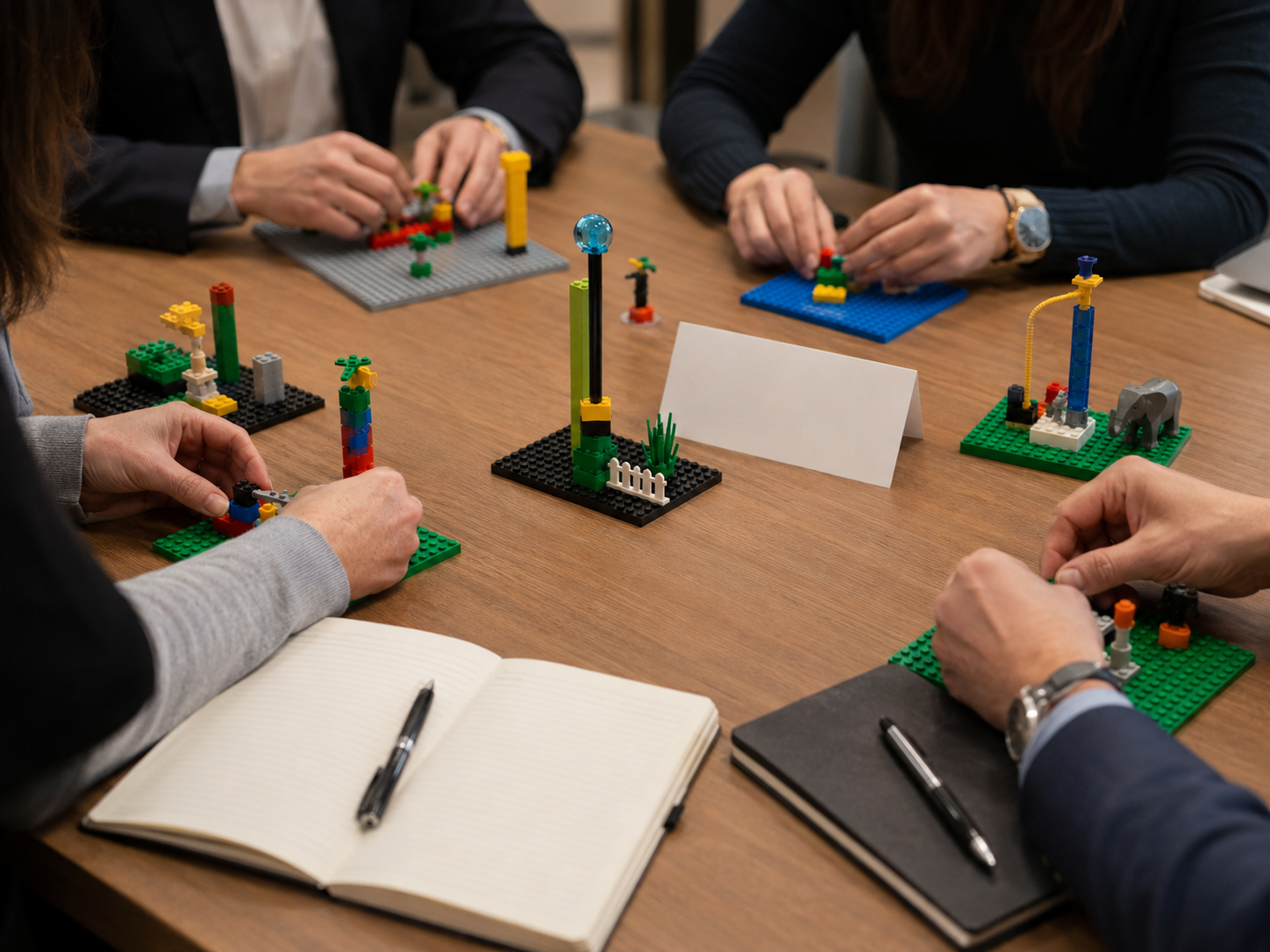
Participation becomes a strategic capability when an organization reliably draws relevant insight from the people who understand the work, the system, and the consequences of its decisions. It matters because strategy depends on the quality of information, and that quality drops whenever contribution is uneven.
LEGO® SERIOUS PLAY® Participation strengthens strategy by tying individual knowledge to collective interpretation. The method never assumes the loudest view is the most accurate one; instead it lays down a structured path for every participant to add meaning.
In leadership development, this turns into real leverage. Leaders learn how their own behavior shapes who contributes, and they learn that silence is never neutral—it is data the system failed to gather.
Strategic participation turns distributed knowledge into visible insight that leaders can interpret before acting.
For Serious Play Business, this is exactly where participation links to strategic facilitation, organizational alignment, and facilitator certification. The method earns its value by helping groups think more completely before they make decisions that carry real weight.
Transform Your Strategy Conversations
Build strategy conversations where every voice counts—and turn private thinking into shared insight your team can act on.
To understand the full methodology behind the workshop design described above, read what LEGO® Serious Play® is and how it works.
Frequently Asked Questions
What is LEGO® SERIOUS PLAY® Participation?
LEGO® SERIOUS PLAY® Participation is the deliberate, structured involvement of everyone in a facilitated organizational conversation. Each participant builds, explains, listens, and reflects, so contribution is balanced before the group settles on any interpretation or decision.
How does LEGO® SERIOUS PLAY® Participation create 100% contribution?
It reaches full contribution by asking every participant to build a model and talk through what it means. That sequence safeguards airtime, curbs dominance, and gives less vocal people a defined place in the discussion.
Why is participation important in organizational alignment?
Alignment rests on shared meaning rather than spoken agreement alone. When everyone contributes, a team can spot clashing assumptions early—well before those assumptions disrupt execution.
What makes LEGO® SERIOUS PLAY® different from traditional workshops?
The difference is that people build before they argue. Conventional workshops tend to favor the verbally confident, whereas the LEGO® SERIOUS PLAY® Method safeguards independent thinking ahead of group convergence.
Does facilitator certification matter for participation quality?
Yes. Certified facilitators are trained to craft prompts, hold the process sequence, manage airtime, and protect meaning ownership—skills that keep the session from sliding into unstructured conversation.