Last Updated by the Serious Play Business Content Team on 28 June 2025.
If you’re trying to figure out the best questions to ask LEGO Serious Play participants during a session to spark deep, meaningful insights — this guide is for you. LEGO® Serious Play® isn’t just about using LEGO® bricks; it’s about asking the kind of questions that unlock storytelling, strategic thinking, and team transformation.
Rather than simply running a session, facilitators shape outcomes through their prompts. Great questions don’t just fill space — they focus attention, surface hidden perspectives, and build momentum. Below, we explore the best questions to use across each stage of the LSP method, plus tips, examples, and a facilitator FAQ.
📌 Top 5 Powerful LEGO® Serious Play® Questions to Try:
- What does this model mean to you?
- What’s the most important part and why?
- How do your models connect as a team?
- What story does your build tell?
- What new insights are emerging from this experience?
🧠 Why Questions Matter in LEGO® Serious Play®
The LSP method, created by Johan Roos and Bart Victor, offers a powerful way to unlock cognitive diversity and collective intelligence. It uses LEGO® bricks to access the brain’s deeper processing through metaphor and hands-on construction.
Questions are the fuel for this process. They guide the conversation, shape meaning, and help participants give voice to ideas they didn’t know they had. When we combine strategic questioning with tactile model building, we tap into neural pathways that pure talk can’t reach. Facilitators like Robert Rasmussen and Gerald Ong often emphasize how key this balance is — structure invites play, and play makes insight possible.
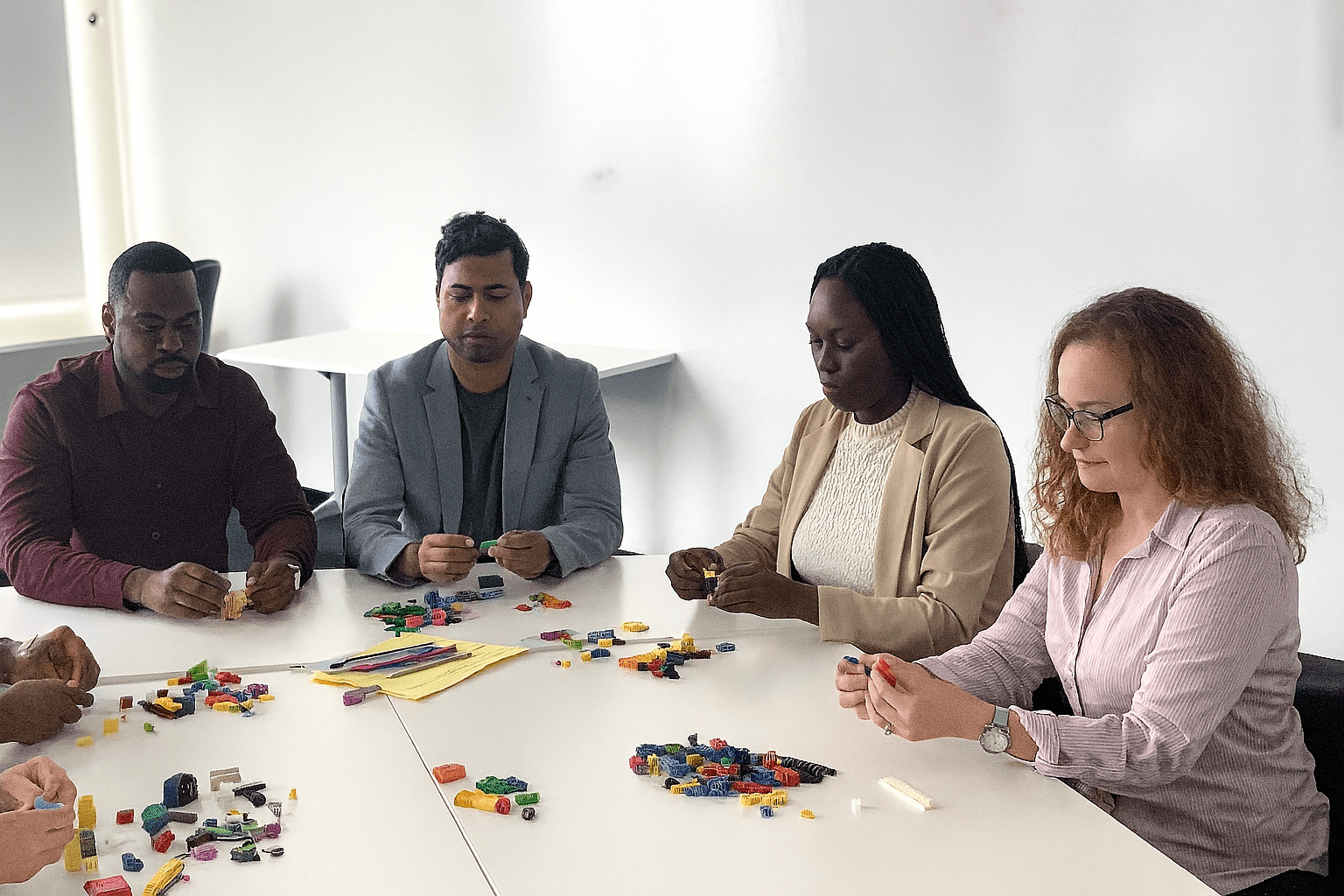
🧩 Types of Questions for Each Stage
🔹 Warm-Up Stage
Help participants ease into the session by using prompts that connect with their everyday experiences and emotions.
- “Describe your morning using LEGO® bricks — how would you build that?”
- “Imagine your mindset as a structure. What kind of foundation does it have?”
- “Instead of telling us how you learn best, show us. Build a metaphorical model that represents it.”
- “Let’s explore your personal values. Which pieces would you choose to reflect them?”
- “If today were a landscape, what would it look like?”
These openers aren’t just icebreakers — they build psychological safety and prime the brain for creative thinking.
🔹 Individual Building
As participants move into more purposeful construction, questions should start guiding interpretation and reflection.
- “Which part of your build feels the most important — and why?”
- “What story does this model begin to tell about your role or challenge?”
- “Was anything unexpected revealed while building?”
- “If your model had a title, what would it be?”
- “What aspects of your leadership style are represented here?”
At this point, they’re not just building objects. They’re building insight.
🔹 Shared Model Creation
Encourage synthesis and group storytelling with collaborative prompts.
- “What common threads are emerging from each individual model?”
- “If this group creation were a machine, where are the gears — and where’s the friction?”
- “What’s missing? What would make the whole more complete?”
- “How do these models align with your team’s vision or strategic goals?”
- “What kind of system are we looking at here — and what’s driving it?”
Collaboration deepens when people can see alignment in 3D, not just talk about it.
🔹 Reflection & Insight
End with prompts that draw out personal meaning, group learning, and action planning.
- “What insight surprised you the most today?”
- “How has your thinking shifted from when we started?”
- “If this model could speak directly to you, what message would it give?”
- “What would you change now, and why?”
- “What’s your next move based on what you’ve built?”
The final reflection isn’t the end — it’s a bridge to real-world application.

🙋♀️ FAQ – Facilitator Questions About Questions
Q: What if participants find it hard to answer metaphorical questions?
🅰️ A great approach is to begin with descriptive prompts and gradually introduce metaphor.
Q: Can I reuse the same questions in every session?
🅰️ You can, but it’s best to vary your phrasing. Prompts will land differently depending on the context and the team.
Q: How do I tailor questions for different industries?
🅰️ In tech, ask about complexity. In HR, focus on team dynamics.
Q: How many questions should I prepare for a session?
🅰️ Aim for 3–5 questions per stage, so you can adapt based on group dynamics.
Q: Should questions always be open-ended?
🅰️ Yes. Ask “what,” “how,” and “why” to keep reflection going.
Q: Where can I find more sample questions?
🅰️ Our certification program includes curated sets, and new blogs offer deep dives per industry.