Last Updated by the Serious Play Business Content Team on March 5, 2026.
LEGO® SERIOUS PLAY® for organisational change offers a powerful facilitation methodology. It helps leadership teams navigate complex transformations. Specifically, it makes assumptions, risks, and system relationships clearly visible.
In 2026, organisational change goes beyond simply implementing new strategies. Instead, it focuses on aligning people, structures, and decisions across interconnected systems. Leaders building careers in transformation must master the ability to guide organisations through change. Furthermore, successful transformation rarely depends on the strategy alone. Ultimately, it relies on leaders sharing a coherent understanding of the change’s actual meaning.
Insight: A major challenge exists. Most change initiatives fail quietly long before anyone declares them unsuccessful. Consequently, organisational change fails less from active resistance. Rather, it fails from invisible misalignment between strategy, leadership behaviour, and operational systems.
The Problem: Why Organisational Change Often Stalls
Organisational change refers to any structured effort to shift how a company operates, competes, or delivers value. Common examples include digital transformation, restructuring, cultural change, new strategy rollouts, and leadership transitions. Unavoidably, these initiatives introduce structural disruption. They challenge existing assumptions about how the organisation works.
Surprisingly, change initiatives rarely fail because teams chose the wrong strategy. Instead, they fail because leaders interpret that strategy differently. When this happens, teams prioritise different objectives. Meanwhile, departments protect their local interests. Consequently, communication becomes inconsistent, and employees receive conflicting signals.
Ultimately, these patterns create systemic friction. This friction slows decision-making and heavily erodes trust. Transformation breaks down when leaders mistakenly believe they share the same strategy. In reality, they operate from entirely different mental models.
The Hidden Cost of Misaligned Change Initiatives
Organisations invest enormous resources into transformation. However, global research on change initiatives reveals a grim picture. First, roughly 60–70% of transformation programmes fail to meet their intended outcomes. Second, strategic initiatives frequently lose 25–35% execution momentum due to internal misalignment. Finally, leadership teams spend 30–40% of their meeting time simply clarifying misunderstandings.

These costs accumulate slowly. Therefore, they remain very difficult to diagnose. Change initiatives often involve multiple departments and leadership layers. As a result, small misunderstandings quickly propagate across the organisation. Misalignment easily spreads through informal interpretations.
When strategy remains abstract, each department fills the gaps with its own specific interpretation. Over time, the organisation unknowingly develops parallel versions of the exact same transformation.
Why Traditional Change Workshops Are Limited
Most change initiatives rely heavily on familiar tools. These include strategy presentations, project roadmaps, executive discussions, and leadership town halls. Unfortunately, these formats wrongly assume that communication automatically produces understanding.
In practice, they often produce the exact opposite result. Slides quickly communicate conclusions but rarely expose the underlying reasoning. Likewise, open discussion rewards persuasive communication but easily hides personal uncertainty.
Senior leaders may appear perfectly aligned during a meeting. Yet, they interpret the outcomes completely differently afterward. Often, verbal agreement masks deep conceptual disagreement. Participants simply interpret the same words through their different organisational experiences. Consequently, traditional change management tools rarely address this fundamental cognitive gap.
The Cognitive Foundation of the LEGO® SERIOUS PLAY® Method
The LEGO® SERIOUS PLAY® Method firmly bases itself on constructionist learning theory. The core principle remains simple. People understand complex ideas much more clearly when they physically construct representations of them. Building actively triggers reflective thinking. Ideas transform into external artefacts rather than lingering as internal abstractions.
Consequently, this shift fundamentally changes the dynamics of leadership conversations. When leaders build models, several things happen:
- Hidden assumptions immediately surface.
- Abstract strategies become highly visible structures.
- Causal relationships become explicitly clear.
- Systemic dependencies finally emerge.
The physical model acts as a powerful shared reference point. Therefore, instead of debating personal interpretations, leaders can objectively examine the system itself. Building shared models successfully transforms strategy discussions. They move from simple opinion exchanges into deep systemic analysis. Additionally, the method strictly enforces equal participation. As a result, it effectively neutralises the hierarchical communication patterns that normally shape executive discussions.

Applying LEGO® SERIOUS PLAY® to Organisational Change
When used in transformation initiatives, the LEGO® SERIOUS PLAY® Method acts as a powerful guide. It helps leadership teams accurately map how change will actually unfold across the organisation. Typically, this process unfolds across three distinct modelling stages.
Click the ‘+’ button below to explore the workshop stages.
1. Individual Change Perspective Models
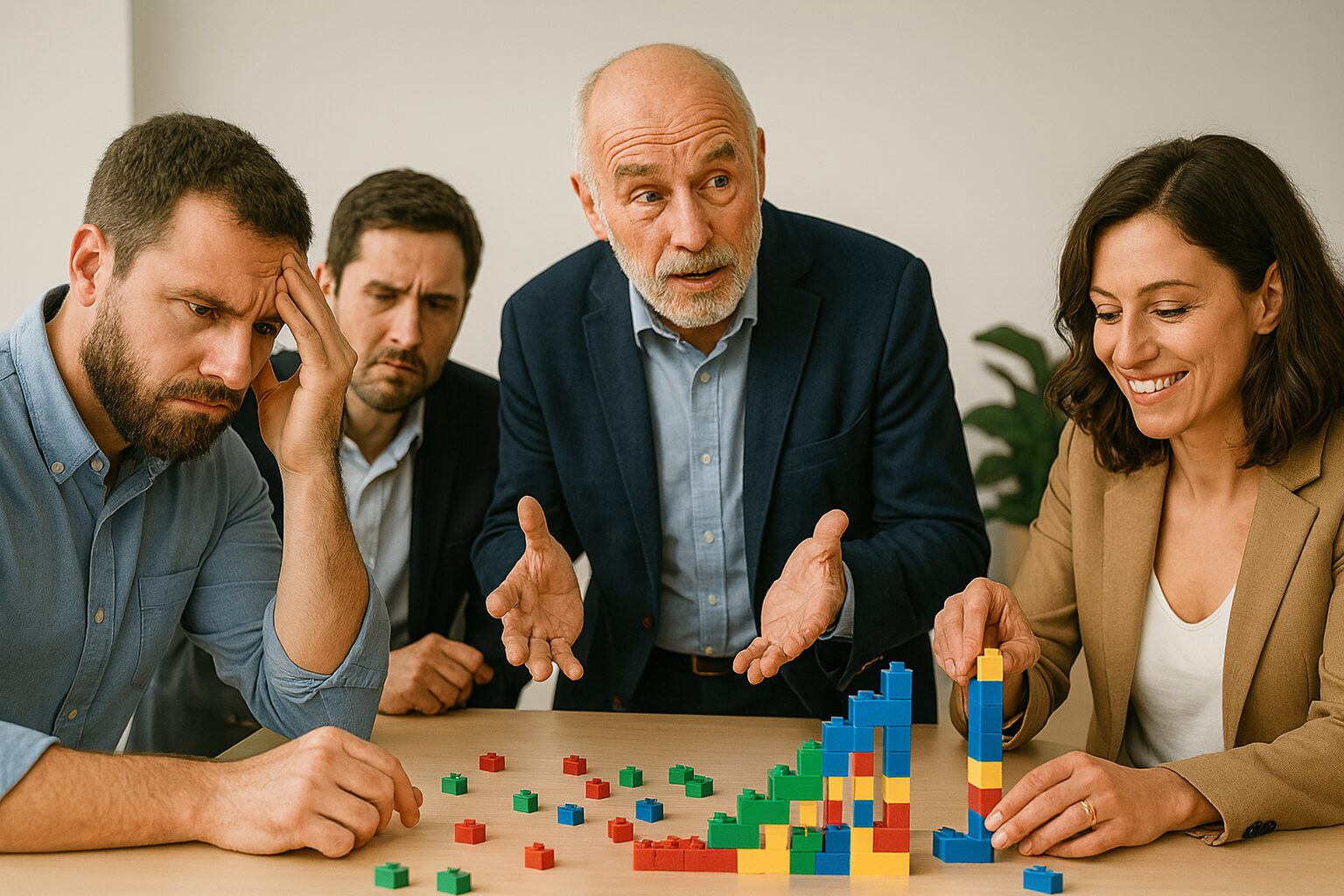
First, each participant builds an individual model. This model represents what the organisational change means to them. It also highlights the risks they anticipate, the opportunities they see, and the barriers they expect. Next, participants proudly share the story behind their model. Because everyone builds and shares, the process explicitly ensures an equal voice. Often, this stage shockingly reveals that leaders define the exact same transformation in significantly different ways.
2. Shared Change Landscape
Afterwards, the team integrates their individual models into a massive collective landscape. They use specific connectors and Landscape Materials to achieve this. This new landscape vividly represents relationships between departments and strategic dependencies. It also highlights potential bottlenecks and vital feedback loops within the system. Consequently, the landscape becomes a clear visual map of the entire transformation system. True alignment finally emerges when leaders clearly see how their specific decisions interact within the broader organisational system.
3. System Stress Testing
Finally, the leadership team introduces hypothetical, real-world disruptions. These might include severe market shocks, sudden leadership turnover, strict regulatory changes, or massive technology failures. The team then adjusts the shared system model in direct response to these events. Ultimately, this active simulation helps leaders identify critical structural vulnerabilities long before the actual transformation unfolds.
Example Organisational Change Workshop Structure
A typical leadership transformation workshop using the LEGO® SERIOUS PLAY® Method follows a highly structured process. The total workshop duration is approximately 4–5 hours. Shorter workshops significantly reduce depth and systemic insight.
- Phase 1 — Skill Building (45 minutes): The facilitator introduces the methodology and participation principles. Participants complete short build exercises. Consequently, an equal voice protocol is established. This stage ensures psychological safety and methodological understanding.
- Phase 2 — Change Perspective Builds (60 minutes): Each leader builds a “Transformation as I See It” model. This leads to an individual storytelling round (3–5 minutes per participant) with clarification questions only. This phase safely reveals divergence without creating confrontation.
- Phase 3 — Shared Transformation Landscape (60–75 minutes): Individual models are combined into one system landscape. Connections are built between strategic elements. The facilitator highlights systemic tensions. Typically, leadership teams identify 4–7 structural alignment gaps during this phase.
- Phase 4 — Scenario Simulation (60 minutes): The team introduces disruption scenarios. They modify the system model in response. This helps identify leverage points and systemic risks. Ultimately, the simulation strengthens collective understanding of how change will unfold.
- Phase 5 — Commitment Mapping (30 minutes): Participants build models representing their specific leadership commitments. This is followed by an alignment discussion, synthesis, and strict documentation of outcomes.
Strategic Outcomes of LEGO® SERIOUS PLAY® in Change Initiatives
Organisations that integrate structured alignment workshops into their transformation initiatives frequently experience highly measurable improvements. Typical positive outcomes include much faster decision cycles and significantly clearer leadership messaging. Teams also notice reduced cross-departmental friction and a stronger shared ownership of the overall strategy.
Because leadership teams successfully develop a common mental model of the transformation system, daily execution becomes far more coherent. Indeed, change initiatives rapidly accelerate when leadership teams share a highly visible model of the system they are actively trying to transform. Therefore, rather than relying solely on static plans and verbal presentations, the organisation builds a robust, shared structural understanding of the change.
Frequently Asked Questions (FAQ)
What is LEGO® SERIOUS PLAY® for organisational change?
LEGO® SERIOUS PLAY® for organisational change is a brilliant facilitation methodology. It helps leadership teams effectively model transformation systems, identify risks, and completely align their understanding of strategic change.
Why use LEGO® SERIOUS PLAY® for transformation initiatives?
LEGO® SERIOUS PLAY® vastly improves transformation initiatives because it reveals hidden assumptions and deep systemic dependencies. Unfortunately, traditional change workshops often completely overlook these crucial elements.
How long does a LEGO® SERIOUS PLAY® change workshop take?
Most organisational change workshops using LEGO® SERIOUS PLAY® take between four and six hours. However, this depends entirely on the complexity of the transformation.
Do facilitators need certification?
Yes. Certified facilitators trained in the LEGO® SERIOUS PLAY® Method are absolutely essential. They ensure the methodology is applied correctly and safely to achieve maximum results.
Closing Reflection & Website Transition Notice
In 2026, organisational change is rarely linear. It unfolds within complex systems where strategy, leadership behaviour, and culture interact continuously. Successful transformations occur when leadership teams move from discussing strategy to modelling the systems that shape it. The LEGO® SERIOUS PLAY® Method provides the essential structure that makes this possible.
Note: Play4Business has officially evolved into Serious Play Business as part of our international growth and expanded leadership facilitation services. While the name has evolved, our core commitment to the LEGO® SERIOUS PLAY® Method, executive leadership development, and facilitator certification remains entirely unchanged. To explore our latest insights, leadership programmes, and certification opportunities, please visit Serious Play Business.

Meta-Strategy: Combining LEGO® SERIOUS PLAY® with Theory of Change for Transformational Initiatives
This article outlines a meta-strategy that integrates LEGO® SERIOUS PLAY® with Theory of Change to improve organisational transformation. It argues that moving from abstract verbal strategies to tangible 3D models allows teams to physically build, visualise, and test their causal logic.
Read The Full Article