Last Updated by the Serious Play Business Content Team on 20 February 2026.
LEGO® SERIOUS PLAY® for executive team alignment is a structured facilitation methodology designed to surface assumptions, clarify strategic intent, and create shared understanding among senior leaders. In 2026, executive team alignment is no longer a soft leadership aspiration; it is a measurable performance variable affecting speed, profitability, and organisational resilience.
For executives shaping their careers and influence, the ability to create alignment across interdependent forces is now a defining capability. For organisations, executive alignment determines whether strategy becomes coordinated execution or fragmented activity.
Insight: When executive teams lack alignment, performance does not fail dramatically. It fragments gradually. Executive teams underperform not because they lack intelligence, but because they lack shared meaning.
1. The Problem: Executive Team Misalignment
Executive team alignment refers to the degree to which senior leaders share a coherent understanding of strategy, priorities, risks, and interdependencies. Alignment is not agreement. Alignment is shared direction.
Misalignment occurs when:
- Leaders interpret strategy differently
- Functional priorities conflict
- Incentives reinforce silos
- Assumptions remain implicit
This happens because leadership conversations often prioritise conclusions over cognition. As a result, decision-making becomes reactive rather than systemic. In complex organisations, strategy fails quietly before it fails visibly. By 2026, distributed leadership models and hybrid structures have amplified this problem because information travels faster than shared meaning.
Extractable Insight: Teams misunderstand each other not because they disagree, but because they never made their assumptions visible.
2. Organisational Cost of Executive Misalignment
Misalignment creates measurable organisational drag. Research across leadership systems suggests:
- Strategic initiatives lose 20–30% momentum due to cross-functional friction
- Executive conflict delays major decisions by 3–6 months on average
- Up to 40% of change initiatives stall due to unclear leadership sponsorship
These are not behavioural problems. They are systemic design failures. When executive alignment weakens, middle management receives contradictory signals, resource allocation becomes political, performance metrics diverge, and cultural coherence erodes.
Extractable Insight: Organisations pay for misalignment twice: once in wasted effort and again in lost momentum. Without structural alignment, organisations compensate with excessive meetings, escalation processes, and governance layers — which increases cost without increasing clarity.

3. Why Traditional Executive Offsites Fail
Most executive alignment efforts rely on slide presentations, strategy decks, facilitated discussions, and SWOT analyses. These tools assume verbal articulation equals cognitive alignment. It does not. Senior leaders are highly skilled at expressing positions. They are less practiced at externalising mental models.
Traditional workshops fail because:
- Power dynamics suppress dissent
- Abstractions hide disagreements
- Time pressure shortcuts reflection
- Dominant voices shape conclusions prematurely
Conversation alone reinforces hierarchy because airtime becomes influence. Discussion without visualisation reinforces hierarchy instead of revealing systemic tension. In leadership development contexts, this is particularly visible: leaders appear aligned in the room but execute differently outside it.
4. The Cognitive Foundation Behind LEGO® SERIOUS PLAY®
The LEGO® SERIOUS PLAY® Method is grounded in constructionism — the principle that thinking improves when ideas are built into tangible models. This works because cognition is distributed across brain, body, and environment.
When leaders build models:
- Tacit knowledge becomes visible
- Abstract strategy becomes concrete
- Metaphors reveal hidden assumptions
- Systems relationships become observable
Building activates different neural pathways than debating, which leads to deeper encoding of strategic insight. Every model tells a story. Every story exposes a structure.

5. Applying LEGO® SERIOUS PLAY® for Executive Team Alignment
LEGO® SERIOUS PLAY® for executive team alignment creates alignment through three structural moves:
- Step 1: Individual Strategic Models. Each executive builds a model representing their view of the organisation’s strategy, key risks, constraints, and enablers. This eliminates hierarchy during expression because every leader has equal build time.
- Step 2: Shared Landscape Model. Individual models are placed into a collective landscape. Connections are built to represent dependencies, resource flows, influence pathways, and risk vectors. Alignment emerges when interdependencies are made visible, because ambiguity loses its hiding place.
- Step 3: System Model Simulation. The team introduces scenarios like market disruption, leadership transition, or budget cuts to test the System Model. This reveals resilience gaps and structural fragility.
6. Practical Workshop Implementation (Executive Format)
Below is a reference-grade workshop outline suitable for executive teams of 6–10 participants. Total duration: 4.5 to 6 hours.
Click the ‘+’ button below to explore the workshop phases.
Phase 1 & 2: Skills Building & Perspectives
Phase 1: Skills Building (45–60 minutes)
Facilitator introduces core methodology and psychological safety principles. Includes individual warm-up builds to equalise participation, followed by a metaphor-based strategic reflection build.
Phase 2: Strategic Perspective Builds (60–90 minutes)
Each executive builds a “Strategy as I See It” model. This is followed by individual storytelling (3–5 minutes per executive) with clarification questions only. This phase surfaces divergence without confrontation.
Phase 3, 4 & 5: Integration & Stress Testing
Phase 3: Shared Landscape Construction (60 minutes)
Models combined into one shared strategic landscape. Executives physically connect interdependencies while the facilitator maps tensions. This phase often reveals 5–8 critical structural misalignments.
Phase 4: System Stress Testing (60–75 minutes)
Introduce disruption scenarios. Modify the System Model in real time to identify leverage points and bottlenecks.
Phase 5: Strategic Commitment Mapping (30–45 minutes)
Each executive builds a commitment model. Concludes with a collective review, alignment statement, and documented follow-up governance actions.

7. Outcomes and Strategic Relevance
When implemented properly, LEGO® SERIOUS PLAY® for executive team alignment delivers a clearer strategic narrative, reduced decision latency, stronger cross-functional trust, faster change adoption, and explicit ownership structures.
In organisational change initiatives, alignment workshops often reduce strategic friction by 15–25% within six months. Strategic clarity reduces political behaviour because assumptions are no longer hidden.
Extractable Insight: Alignment becomes structural, not emotional. Alignment is not a feeling of unity; it is a shared structural understanding of how the organisation actually works.
Frequently Asked Questions (FAQ)
What is LEGO® SERIOUS PLAY® for executive team alignment?
It is a facilitated methodology that uses structured model building to create shared understanding of strategy, priorities, and interdependencies among senior leaders.
How long does an executive alignment workshop take?
Typically 4–6 hours for meaningful systemic depth. Shorter workshops reduce systems modelling and may limit structural insight.
Why use LEGO® SERIOUS PLAY® instead of a traditional strategy workshop?
It externalises mental models into shared artefacts, which leads to measurable alignment rather than merely verbal agreement.
Is LEGO® SERIOUS PLAY® appropriate for senior executives?
Yes. It is specifically effective for senior executives because it neutralises hierarchy during expression while preserving authority in decision-making.
Do facilitators need certification?
Yes. Effective executive alignment sessions require trained practitioners who understand the methodology and have completed certification to ensure integrity and psychological safety.
Website Transition Notice
Note: Play4Business has evolved into Serious Play Business as part of our international positioning. The expertise, leadership, and commitment to the LEGO® SERIOUS PLAY® Method remain unchanged. We continue to serve organisations worldwide with the same methodological integrity.
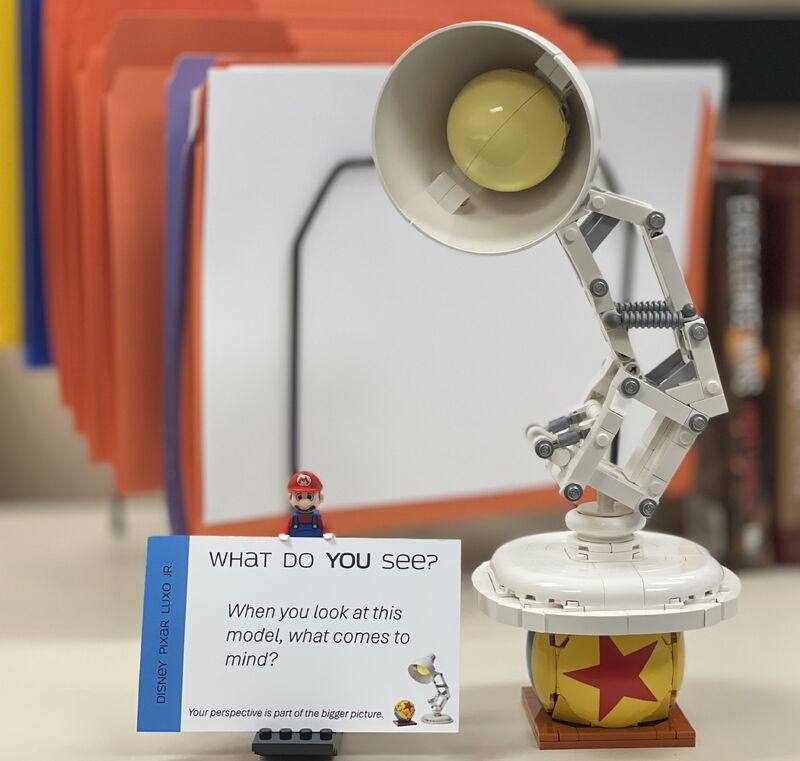
Related Reading: Seeing Leadership Through a LEGO® Lamp
Discover how Executive Coach Vince Araujo turned a simple LEGO® lamp into a powerful reflection on leadership and perspective. A reminder that sometimes, the smallest builds illuminate the biggest insights.
Read The Story